In the high-stakes world of legal operations and e-discovery, the gap between an average team and an exceptional one is vast. It’s not just about individual talent; it’s about the collective chemistry and operational discipline that transform a group of professionals into a powerhouse. The most common question I, Pablo Tascon, hear from legal departments is: "What truly separates the best from the rest?" The answer lies in a specific set of learnable behaviors and environmental factors that define the characteristics of effective teams.
This article breaks down the 8 fundamental qualities that high-performing teams share, providing a practical blueprint for leaders aiming to build resilient, efficient, and highly collaborative units. Forget abstract theories. We are diving into actionable strategies and real-world examples you can implement immediately to elevate your team’s performance. Whether you're navigating complex document reviews or managing large-scale platform rollouts, these principles are your guide.
We will explore the core components that drive exceptional results, moving beyond generic advice to offer specific, tactical guidance. Let's examine the blueprint for building a team that consistently delivers under pressure.
1. Clear and Shared Vision
One of the foundational characteristics of effective teams is a clear and shared vision. This is more than just a mission statement; it's a deeply ingrained, mutually understood purpose that aligns every member's efforts toward a common objective. In the high-stakes world of legal and e-discovery, where projects involve complex data and tight deadlines, a shared vision acts as a north star. It guides decision-making, prioritizes tasks, and ensures that every individual contribution, from a paralegal's document review to a partner's legal strategy, is moving the team in the same direction.

This alignment provides clarity and motivation. When a legal team shares a vision to achieve the best possible outcome for a client in a complex litigation case, every decision is filtered through that lens. This prevents disjointed efforts and internal friction, creating a unified force. As management thinkers like Peter Senge and Jim Collins have emphasized, a compelling vision transforms a group of individuals into a cohesive, high-performing unit focused on a future state they collectively want to create.
How to Implement a Shared Vision
Building and maintaining a shared vision requires deliberate and consistent effort. It doesn't happen by accident.
- Co-create the Vision: Involve all team members in the process of defining the team's purpose and goals. This fosters a sense of ownership and ensures the vision resonates with everyone, rather than being a top-down mandate.
- Establish SMART Goals: Translate the broad vision into specific, measurable, achievable, relevant, and time-bound (SMART) objectives. For an e-discovery team, this could mean reducing data processing time by 15% over the next quarter.
- Communicate Constantly: Regularly connect daily tasks back to the larger vision. During team meetings, start by reminding everyone of the overarching goal and then discuss how current projects contribute to it.
- Visualize the Purpose: Create visual reminders like dashboards, posters, or intranet banners that display the team's vision and progress toward key goals. This keeps the objective top-of-mind and reinforces its importance.
2. Open and Honest Communication
Another of the core characteristics of effective teams is a culture of open and honest communication. This goes beyond simple information exchange; it's about creating an environment of psychological safety where team members can share ideas, voice concerns, and offer constructive feedback without fear of negative consequences. In the detail-oriented fields of legal and e-discovery, where a single overlooked piece of data can alter a case's outcome, transparent communication is the lifeblood that prevents critical errors and fosters innovation.

When communication is open, problems are identified and solved faster. A junior paralegal feels safe to question a senior attorney's interpretation of a document, potentially preventing a costly mistake. This concept is championed by thinkers like Amy Edmondson, whose research on psychological safety proves that teams thrive when members feel secure enough to be vulnerable. As seen in models like Pixar's "Braintrust" meetings, where candid feedback is essential to creative excellence, this practice transforms a team from a group of individuals into a synergistic problem-solving entity.
How to Implement Open and Honest Communication
Fostering an environment of trust and transparency requires intentional leadership and consistent team habits. It must be actively cultivated.
- Establish Clear Ground Rules: Begin by collaboratively setting guidelines for respectful communication. This can include active listening without interrupting, focusing on the issue instead of the person, and committing to constructive, not destructive, criticism.
- Practice Active Listening: Train team members to listen to understand, not just to reply. This involves paraphrasing what others have said to confirm understanding and asking clarifying questions to explore ideas more deeply.
- Model Vulnerability: Leaders must set the tone. By openly admitting their own mistakes or uncertainties, they show the team that it is safe for everyone to do the same, building trust and encouraging honesty.
- Utilize Structured Feedback Channels: Implement regular forums for communication, such as one-on-one check-ins, "lessons learned" debriefs after a project, and even anonymous feedback surveys to address sensitive topics.
3. Mutual Trust and Respect
Trust is the psychological bedrock upon which all other characteristics of effective teams are built. It's the confident belief that team members are competent, reliable, and have good intentions toward one another. In the high-pressure environment of legal and e-discovery work, where the integrity of a case can hinge on a single action, mutual trust and respect are non-negotiable. This means every team member, from the senior partner to the document review specialist, has confidence that their colleagues will follow through on commitments and act in the team's best interest.

When trust is high, teams move faster and with greater efficiency, a concept Stephen M.R. Covey calls "The Speed of Trust." There's no need for micromanagement or second-guessing, which frees up mental and emotional energy for complex problem-solving. A culture of trust encourages vulnerability, allowing team members to admit mistakes or ask for help without fear of blame, which is critical for innovation and continuous improvement. This creates a resilient team that can navigate setbacks and complex challenges together.
How to Cultivate Mutual Trust and Respect
Building trust is a deliberate process that requires consistent behavior from every member of the team, especially its leaders. It is earned through actions, not words.
- Demonstrate Reliability: Consistently follow through on all commitments, both large and small. Meeting deadlines and fulfilling promises builds a reputation for dependability, which is the cornerstone of trust.
- Practice Transparency and Honesty: Admit mistakes quickly, take responsibility, and communicate openly about challenges and decisions. This vulnerability shows integrity and encourages others to do the same.
- Give Credit Generously: Actively acknowledge and celebrate the contributions of others. Recognizing individual efforts reinforces a culture of appreciation and respect, making team members feel valued.
- Show Genuine Care: Take an interest in colleagues as individuals, not just as coworkers. Understanding their perspectives and showing empathy builds strong interpersonal bonds that strengthen professional trust.
4. Complementary Skills and Roles
Another one of the core characteristics of effective teams is the strategic assembly of complementary skills and roles. High-performing teams are far more than a collection of talented individuals; they are a carefully curated blend of diverse expertise, experiences, and perspectives. This synergy allows the team to tackle complex challenges that no single member could manage alone. In the legal and e-discovery fields, a project’s success often hinges on combining deep legal acumen with technical prowess, project management discipline, and forensic expertise.
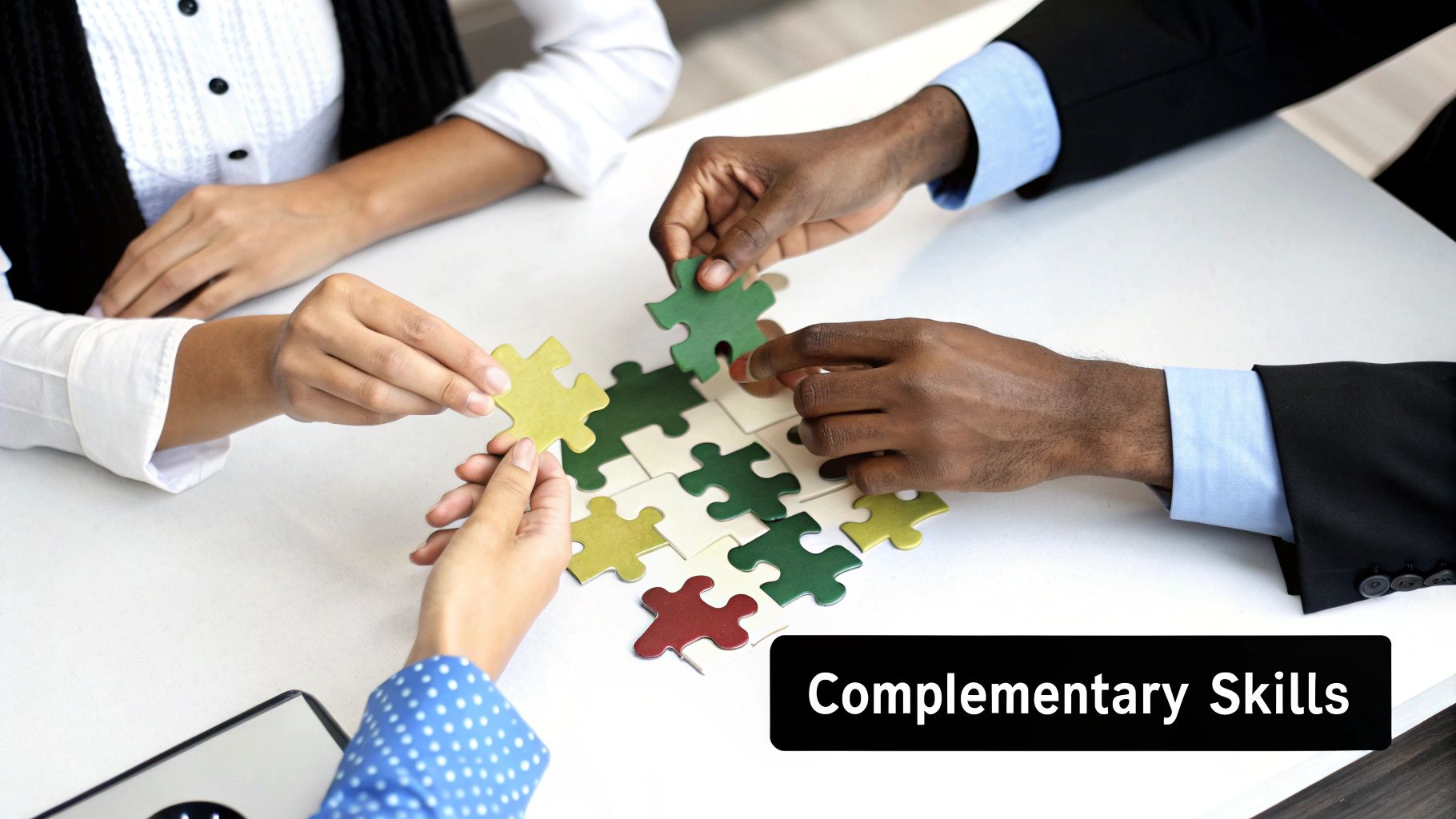
When roles are clearly defined based on individual strengths, the team operates with precision and efficiency. Consider a large-scale document review project: one member may excel at crafting complex search queries (technical skill), another at quality control (detail-oriented), and a third at summarizing key findings for the legal team (communication skill). This division of labor, popularized by thinkers like Meredith Belbin with his team role theory, minimizes weaknesses and maximizes collective output. The goal is to create a cohesive unit where each person's unique contribution is essential to the whole.
How to Implement Complementary Roles
Building a team with a balanced and complementary skill set requires a proactive and intentional approach to team composition and management.
- Conduct a Skills Inventory: Start by mapping out the existing skills and competencies within your team. Use assessments like Gallup's StrengthsFinder or a simple internal survey to identify both technical abilities and soft skills.
- Define Roles with Clarity: Create a role and responsibilities matrix (RACI chart) for key projects. This document should explicitly state who is Responsible, Accountable, Consulted, and Informed, preventing overlap and ensuring all critical tasks are covered.
- Hire to Fill Gaps: When recruiting new members, prioritize candidates whose skills complement the existing team. Instead of hiring another person with the same strengths, look for individuals who bring new perspectives and fill identified gaps.
- Promote Cross-Training: Encourage team members to share their knowledge and learn from one another. This not only builds individual capabilities but also increases the team’s overall resilience, allowing members to cover for each other when needed.
5. Strong Leadership and Facilitation
A critical characteristic of effective teams is the presence of strong leadership that emphasizes facilitation over command. This style of leadership focuses on guiding and supporting the team's work rather than simply directing it. In the context of a high-pressure e-discovery project or a complex legal case, a facilitative leader creates the conditions for success by removing obstacles, securing resources, and empowering team members to contribute their best work. They function as a catalyst, enabling the collective intelligence of the group to flourish.
This approach, championed by leadership experts like Robert Greenleaf with his "servant leadership" model, fundamentally shifts the leader's role from a director to an enabler. Think of Ernest Shackleton's leadership during the Endurance expedition; his focus was entirely on the survival and success of his crew. This leadership style builds trust, encourages autonomy, and fosters a culture where team members feel supported and valued, leading to higher engagement and better outcomes. The leader’s primary goal becomes elevating the team's performance, not their own status.
How to Implement Strong Leadership and Facilitation
Developing a facilitative leadership style requires a conscious shift in mindset and behavior. It is an active, ongoing process of empowerment and support.
- Serve, Don't Command: Adopt a "servant leadership" mentality. Prioritize the needs of your team by asking, "What do you need to succeed?" and then actively work to provide it.
- Delegate Authority: When assigning tasks, delegate the necessary authority along with the responsibility. This empowers team members to make decisions and take ownership of their work, fostering accountability and growth.
- Ask Guiding Questions: Instead of always providing answers, facilitate problem-solving by asking powerful questions. This encourages critical thinking and helps the team develop its own solutions.
- Shield the Team: Protect your team from unnecessary external pressures, political distractions, or bureaucratic hurdles. This allows them to maintain focus on their core objectives and perform at their best. As a key aspect of legal operations management, effective leaders ensure their teams can operate with maximum efficiency.
6. Collaborative Decision-Making
A hallmark characteristic of effective teams is a commitment to collaborative decision-making. This process moves beyond top-down directives, instead leveraging the collective intelligence, diverse perspectives, and varied expertise of the entire team. In the fast-paced and detail-oriented field of e-discovery, where a single decision can significantly impact case strategy and costs, this approach is invaluable. It ensures that choices are well-vetted, potential risks are identified early, and team members are invested in the outcome.
This inclusive model fosters innovation and buy-in. When a legal team collaboratively decides on a keyword search strategy or a technology-assisted review protocol, the resulting plan is more robust and defensible. This process reflects the principles advocated by thinkers like Daniel Kahneman, who highlighted the biases in individual decision-making, and Chip and Dan Heath, who developed frameworks for making better choices. By involving multiple stakeholders, teams can mitigate individual biases and arrive at more sound, strategic conclusions. Exploring how this works within electronic discovery services reveals its practical benefits in complex legal matters.
How to Implement Collaborative Decision-Making
Fostering a culture of collaborative decision-making requires structure and intentionality to remain efficient and effective.
- Define Decision Authority: Clearly establish who makes what types of decisions. Use a RACI (Responsible, Accountable, Consulted, Informed) chart to define roles for key processes, ensuring everyone knows when their input is required versus when a decision will be made by a designated lead.
- Use Structured Frameworks: Employ techniques like Edward de Bono's "Six Thinking Hats" to explore a decision from multiple angles or use a simple pros/cons list for smaller choices. This prevents discussions from becoming disorganized and ensures all facets of an issue are considered.
- Ensure All Voices Are Heard: Actively solicit input from quieter team members. Use round-robin techniques in meetings where each person is asked for their thoughts, preventing the loudest voices from dominating the conversation.
- Document and Communicate Outcomes: Once a decision is made, document the rationale and the final choice. Communicate it clearly to the entire team and relevant stakeholders to ensure alignment and prevent confusion during implementation.
7. Accountability and Commitment
Among the most critical characteristics of effective teams is a deeply ingrained culture of accountability and commitment. This means team members hold themselves and each other responsible for their commitments, actions, and results. It's about taking ownership, not just of individual tasks, but of the team's collective success. In legal and e-discovery environments, where project outcomes depend on the precise execution of interconnected tasks, a lack of accountability can lead to missed deadlines, costly errors, and compromised case strategies.
True accountability creates a high-performance environment where excuses are replaced with solutions. When a team member commits to completing a document review by a certain date, the rest of the team trusts it will be done. This reliability fosters mutual respect and psychological safety, as individuals know they can depend on their colleagues. As Patrick Lencioni highlights in his work on team dynamics, accountability is the discipline that ensures commitments are met, transforming a well-intentioned group into one that consistently delivers results.
How to Foster Accountability and Commitment
Building a culture of accountability requires clear standards and consistent reinforcement. It doesn't materialize on its own; it must be intentionally cultivated.
- Set Clear Expectations Upfront: Define roles, responsibilities, and performance standards from the outset of any project. Ensure every team member knows exactly what they are responsible for and what success looks like.
- Establish Regular Check-ins: Implement daily stand-ups or weekly review meetings where team members report on progress and roadblocks. This creates a natural and regular forum for accountability without micromanagement.
- Address Issues Directly and Quickly: When commitments are missed, address the issue promptly and constructively. Focus the conversation on finding a solution and learning from the situation, rather than assigning blame.
- Model Accountability from the Top: Team leaders must demonstrate accountability themselves. When leaders openly admit mistakes and take ownership of their responsibilities, they set a powerful precedent for the rest of the team. For more information, explore these contract management best practices on tasconlegal.com which underscore the importance of clear responsibilities.
8. Continuous Learning and Adaptation
Stagnation is the enemy of high performance. One of the most vital characteristics of effective teams is a commitment to continuous learning and adaptation. This means the team doesn't just execute tasks; it actively reflects on its processes, learns from both successes and failures, and evolves its approach. In the dynamic fields of legal tech and e-discovery, where regulations, technologies, and case strategies are constantly changing, a team's ability to adapt is a primary determinant of its long-term success.
This quality transforms a team from a static operational unit into a dynamic learning organization. Influential thinkers like Peter Senge and W. Edwards Deming have championed this idea, emphasizing that sustainable success comes from building a culture of inquiry and improvement. For a legal team, this could mean analyzing the workflow of a recently concluded e-discovery project to find bottlenecks or adopting a new technology to stay ahead of data complexity. It's an ingrained mindset that challenges the status quo in pursuit of excellence.
How to Implement Continuous Learning and Adaptation
Fostering a culture of continuous improvement requires creating structured opportunities for reflection and change. This process must be intentional and consistently supported by leadership.
- Schedule Regular Retrospectives: After a major project phase or a complex case review, schedule a formal "after-action review" or retrospective meeting. The goal is to openly discuss what went well, what didn't, and what can be improved next time.
- Focus on Process, Not Blame: Create a psychologically safe environment where team members can provide honest feedback without fear of retribution. The focus should always be on improving the system and process, not assigning personal blame for mistakes.
- Document and Share Lessons Learned: Create a simple, accessible repository for key takeaways from each project. This "lessons learned" log becomes an invaluable resource for onboarding new members and planning future work, preventing the team from repeating past errors.
- Experiment with Small Changes: Encourage the team to test new ideas and small process tweaks. A concept from Eric Ries' lean startup methodology, this allows the team to validate improvements on a small scale before implementing major, disruptive overhauls.
8 Key Characteristics Comparison
| Item | Implementation Complexity 🔄 | Resource Requirements ⚡ | Expected Outcomes 📊 | Ideal Use Cases 💡 | Key Advantages ⭐ |
|---|---|---|---|---|---|
| Clear and Shared Vision | Medium – requires time to develop and update regularly | Moderate – needs ongoing communication and visualization | Alignment and motivation across team; improved coordination | Strategic projects; long-term goals; highly aligned teams | Increases engagement; reduces confusion; fosters accountability |
| Open and Honest Communication | Medium to High – needs protocols and psychological safety | Moderate to High – requires time for meetings and feedback | Trust building; faster problem-solving; innovation boost | Creative teams; high-stakes problem-solving; innovation-driven | Builds trust; improves decision quality; reduces conflicts |
| Mutual Trust and Respect | High – takes significant time to build and maintain | Low to Moderate – requires consistent behavior and follow-through | Faster decisions; risk-taking; resilience and job satisfaction | High-reliability teams; diverse work environments | Reduces oversight; improves satisfaction; enhances resilience |
| Complementary Skills and Roles | Medium – requires assessment and ongoing role management | Moderate – investment in training and cross-functional collaboration | Better problem solving; creativity; adaptability | Complex projects; multidisciplinary teams | Enables handling complexity; increases innovation; learning opportunities |
| Strong Leadership and Facilitation | Medium – depends on leadership skill development | Moderate – coaching, decision-making support | Clear direction; obstacle removal; capability building | Teams needing guidance; crisis or high-pressure situations | Provides direction; removes barriers; develops team members |
| Collaborative Decision-Making | Medium to High – structured processes and time management | Moderate – time for meetings and documentation | High-quality decisions; team buy-in; skill development | Teams requiring consensus; innovation-driven environments | Improves decision quality; builds ownership; reduces risks |
| Accountability and Commitment | Medium – requires clear expectations and ongoing monitoring | Moderate – time for reviews and feedback | Consistent performance; ownership; continuous improvement | Performance-driven teams; high-stakes goals | Ensures reliability; builds trust; drives improvement |
| Continuous Learning and Adaptation | Medium – requires discipline for regular reflection | Moderate – time for retrospectives and experimentation | Improved performance; adaptability; prevents stagnation | Agile teams; dynamic markets; improvement-focused cultures | Enables resilience; develops capabilities; encourages innovation |
From Theory to Practice: Building Your Elite Legal Team
Understanding the theoretical characteristics of effective teams is a crucial first step, but the real challenge lies in embedding these principles into the DNA of your legal or e-discovery unit. The eight pillars we have explored, from a clear and shared vision to a culture of continuous learning, are not isolated traits. They form a deeply interconnected system that collectively powers high performance.
A breakdown in one area, such as mutual trust, will inevitably weaken others, compromising open communication and diluting accountability. Similarly, strong leadership is essential to facilitate collaborative decision-making, which in turn reinforces a shared commitment to the team's goals. This synergy is what separates good teams from truly elite ones.
Turning Insights into Actionable Strategy
Moving from theory to practice requires a deliberate and focused approach. Rather than attempting a complete overhaul at once, which can lead to team fatigue and resistance, concentrate on one or two areas for immediate improvement. Use this guide as a diagnostic tool to pinpoint both your team's current strengths and its most significant vulnerabilities.
Consider these practical next steps:
- Conduct a Team Audit: Facilitate an honest discussion or anonymous survey based on the eight characteristics. Where do team members feel you excel? Where are the pain points? This qualitative data is invaluable for prioritizing your efforts.
- Target a Keystone Habit: Identify one characteristic that, if improved, would create the most significant positive ripple effect. For many legal teams, enhancing open and honest communication or fostering psychological safety to build trust can unlock progress in all other areas.
- Implement and Measure: Define a specific, measurable initiative to address your chosen focus area. For example, if you're targeting collaborative decision-making, you could implement a new protocol for case strategy meetings that requires input from all team members before a final decision is made. Track the results and gather feedback.
The journey toward building a high-performing team is not a one-time project; it is an ongoing commitment to excellence and adaptation. By mastering these foundational concepts, you are not just improving project outcomes. You are creating a resilient, innovative, and highly engaged legal force capable of navigating the complex challenges of modern litigation and e-discovery with confidence and precision.
At Tascon Legal & Ediscovery, we specialize in helping legal teams put these principles into action. Whether it's through sourcing top UK-qualified talent with the right collaborative mindset or implementing technology that enhances teamwork, we provide the end-to-end support needed to build a truly effective unit. Contact us today to learn how we can help you build your elite team. Tascon Legal & Ediscovery