Software stocks have had a rough week, and the trigger has been easy to spot: Anthropic has started shipping legal and accounting workflow tooling inside Claude Cowork, an agentic version of Claude that can plan tasks, take actions, and iterate towards a finished output.
Some headlines have framed this as a sudden replacement for whole categories of SaaS. The more practical reading is simpler, and more useful for legal ops and eDiscovery teams: if a general AI product you already pay for can do “good enough” contract triage, clause risk-spotting, and templated responses directly in your working folders, a chunk of single-purpose software starts to look optional.
What’s confirmed from current reporting is that Cowork is available as a research preview for paid tiers, that Anthropic has released a Legal plugin (open source) designed for in-house workflows, and that Cowork can connect to tools and files with permissions (including via MCP, plus local file access today). What’s not confirmed in public detail is end-to-end coverage for high-stakes work like defensible litigation holds across jurisdictions, or exactly how UK versus EU privacy requirements are handled inside these new workflows.
This post is about workflow impact, testing, and defensibility, not stock picking.
What Anthropic actually launched, and what it can do today

Claude Cowork is best thought of as “Claude with hands”. Instead of asking a question, copying a reply into Word, then repeating that loop for an hour, you can ask Cowork for an outcome (a reviewed set of contracts, a summary pack, a cleaned spreadsheet), and it will plan steps, run tools, and produce artefacts.
In public descriptions, Cowork is positioned as a teammate that can handle multi-step jobs and keep going without constant prompting. It can also work with files directly (local first), and it uses checkpoints so work can be saved and rolled back. The practical takeaway for legal and finance teams is speed, but also shape: work moves from “chat” to “process”.
For a quick reference on what Anthropic says is improving in its agentic capabilities right now, see Anthropic’s announcement for Claude Opus 4.6, which describes longer-running tasks and more careful planning.
The legal plugin basics: NDA triage, contract review, and compliance checks
Anthropic’s Legal plugin is designed for in-house legal productivity, and it’s been shared publicly as an open repository. The most concrete, checkable detail is in the documentation itself, including commands for contract review and NDA triage. You can see the workflow focus in the Legal plugin README.
In plain terms, the reported capability set maps to what many teams already do manually:
- Identify what a document is (NDA, SaaS agreement, licence, order form).
- Work out which side you’re on (vendor or customer) and what that means.
- Surface key clauses (liability caps, indemnities, assignment, audit rights, termination, governing law).
- Flag issues against a playbook (green, amber, red style outputs are commonly described).
- Draft notes, briefing summaries, and templated responses for review.
The boundary matters: these outputs do not equal legal advice. They’re drafts and flags that still need lawyer sign-off, and they may still miss facts buried in annexes, schedules, or odd definitions.
Where it fits in real workflows: folders, document systems, and custom plugins
The value comes when the assistant sits where work already lives. Cowork has been described as reading and writing local files now, with broader app and cloud integrations expected to expand over time.
Teams also care about customisation. A generic clause checklist is fine for demos, but day-to-day risk calls depend on your clause library, fallback positions, and escalation rules. The fact that Anthropic has open-sourced a set of knowledge-work plugins suggests a “bring your own playbook” path, not just a sealed product.
In early preview, the likely winners are teams with decent legal ops maturity: clear playbooks, good document hygiene, an IT partner who can manage permissions, and someone who can run a controlled pilot without turning the assistant loose on a whole department drive.
Why investors think AI can replace software services, not just speed them up
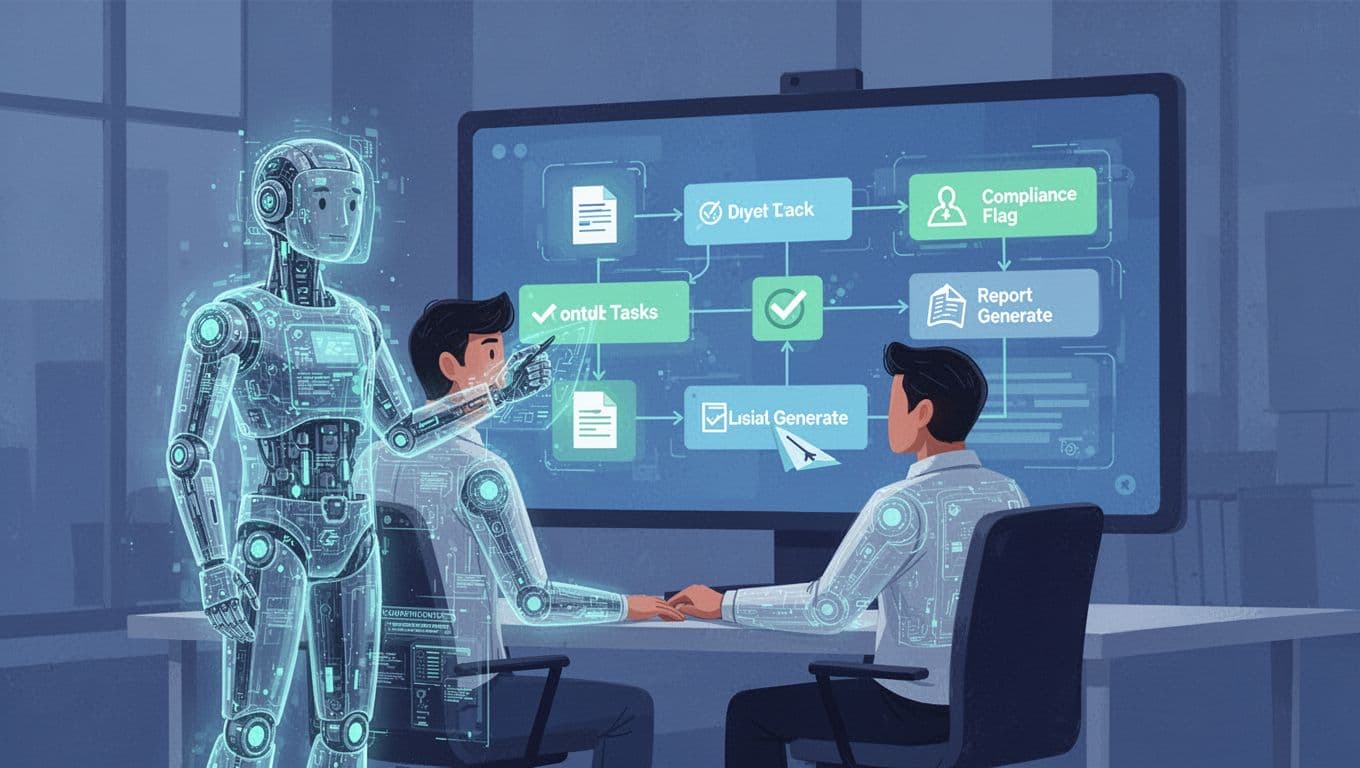
Markets tend to react to the shape of a threat, not the finished product. The fear is not that a single plugin is perfect. It’s that a general AI platform can bundle more and more “good enough” workflows until point solutions get squeezed.
That storyline has been widely covered in the business press. For a snapshot of how this update spooked software investors, see CNN’s coverage of the update that shook software stocks.
From "tool" to "teammate": why agentic AI feels like a platform shift
A normal chatbot answers a prompt. An agentic system can break a job into steps, use tools to do the steps, check its work, and repeat until it’s done.
That difference sounds small until you put it next to legal and accounting work, where the job is often a checklist:
- Identify the document and parties.
- Extract key terms.
- Compare against policy.
- Draft a response.
- Create a record of what you did.
If an AI can do most of that loop on its own, the human role changes. You stop doing first pass review, and start doing supervision, exception handling, and final judgement. That’s why the reaction has been more dramatic than “AI makes lawyers faster”. It hints at a shift in where the work happens.
The bundling threat: one assistant that covers legal, finance, and more
The real pressure comes when buyers think: “We already pay for the assistant, why pay again for a narrow tool that does one part?”
That can hit:
- Contract review and lightweight CLM add-ons (especially first pass review and summarisation).
- Basic compliance triage tools.
- Template-heavy legal request intake.
- Some finance workflows (spreadsheet outputs, invoice triage, variance explanations).
This does not mean specialist vendors are finished. Deep systems still win on integrations, data models, permissions, reporting, and audit trails. But bundling changes procurement maths, and it can reduce switching costs. You can trial a plugin in days, not months.
What this means for eDiscovery and risk teams, and what Claude cannot yet prove
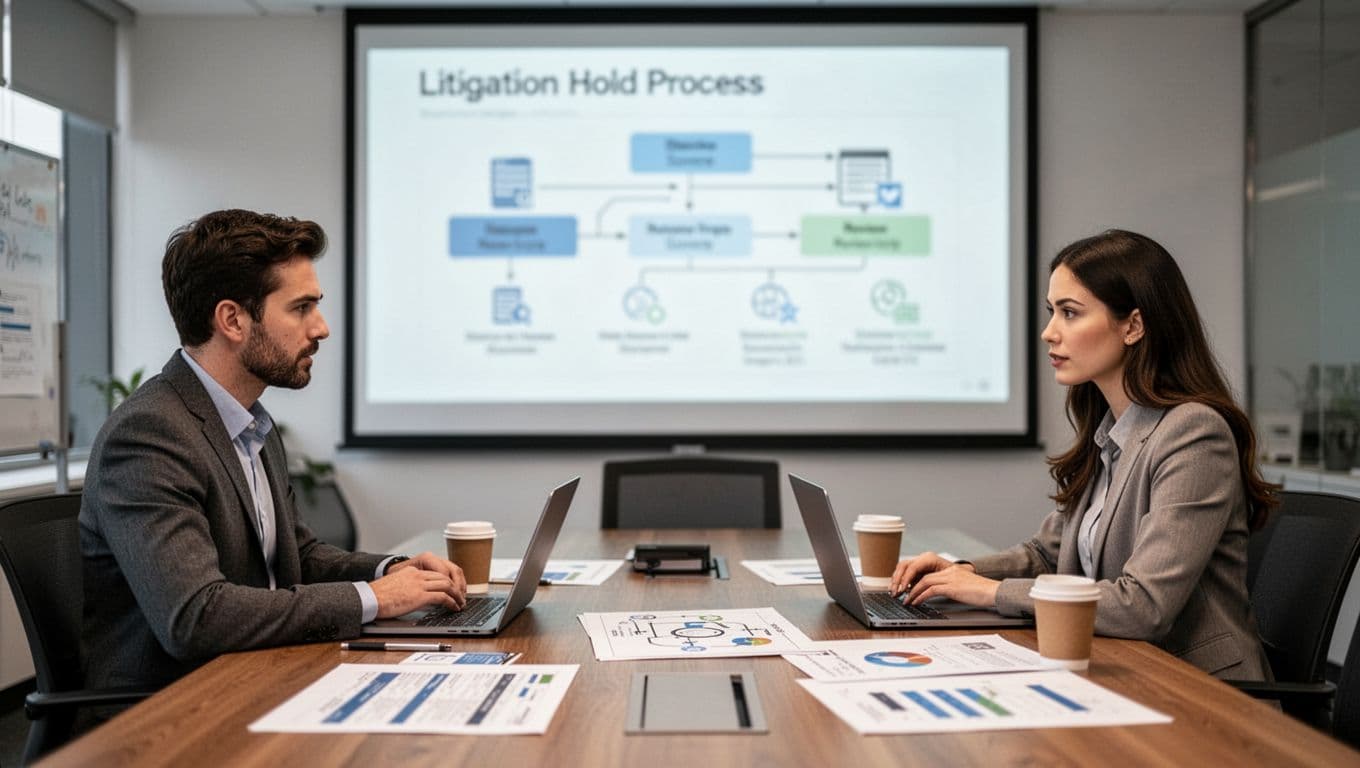
If you work in eDiscovery, you’ll recognise the pattern: the work is half judgement, half repeatable process. Cowork fits the repeatable parts well, but defensibility lives in the details you can prove later.
Some of the best reporting so far has focused on how this could collide with legal tech incumbents. A grounded read is LawNext’s analysis of the competitive implications, which frames this as foundation model providers stepping into legal workflows directly.
Where Claude Cowork could help immediately in eDiscovery adjacent work
Even without claiming full eDiscovery coverage, there are high-volume tasks around matters where a supervised agent can help right away:
Matter intake and early issue spotting: summarise what happened, who’s involved, key dates, and likely data sources, based on initial emails and documents.
NDA and vendor term triage: flag assignment, audit rights, data transfer terms, retention promises, and breach notice timelines that change what you can collect and share.
First pass privilege risk flags: highlight likely privileged communications (counsel names, legal advice phrasing, common headers) so reviewers can prioritise. This is triage support, not a privilege decision.
Drafting artefacts for review: hold notices, custodian questionnaires, collections checklists, review playbooks, and matter summaries.
Mapping the data story: a draft data source map based on system lists and interviews, which humans correct and approve.
Used this way, Cowork is a force multiplier. It reduces blank-page time, and it makes teams faster at producing “first drafts that aren’t embarrassing”.
Hard questions: litigation holds, cross-border privacy, and auditability
Here’s the uncomfortable bit: public detail is still thin on the parts that get challenged in court or by regulators.
If someone says “this can run your litigation hold”, your next sentence should be “show me the logs”.
A simple checklist to ask before you trust an agent with high-stakes work:
- Data residency and transfers: where is data processed, and can you control region?
- Retention and deletion: what is stored, for how long, and how do you prove deletion?
- Access controls: can you enforce least privilege, folder-by-folder, matter-by-matter?
- Audit logs: can you export who did what, when, with what inputs and outputs?
- Chain of custody support: how do you preserve originals and track transformations?
- Prompt and context leakage: what stops sensitive snippets appearing in future outputs?
- Privilege handling: can you segregate counsel work, and prevent commingling?
- Explainability: can it cite the clause or text it relied on, every time?
Cross-border review adds another layer. UK GDPR and EU GDPR share DNA, but organisations still have different risk stances, transfer mechanisms, and regulator expectations. Until vendors are explicit about controls and evidence, treat “it can do holds” as marketing, not a proven process.
Avoiding "agent-washing": how to test AI legal tools before you trust them

“Agent-washing” happens when a product is sold as autonomous, but the hard parts are still manual, hidden behind a glossy demo. The fix isn’t cynicism. It’s testing that matches how legal and eDiscovery teams already prove quality.
A quick proof of value plan: start small, measure errors, then expand
A 2 to 4-week pilot can be enough to learn something real, as long as it’s scoped:
- Pick one workflow with high volume and low downside, like NDA triage or contract issue spotting on standard vendor paper.
- Build a gold set (for example 50 to 150 documents) with agreed “right answers”, including edge cases.
- Define success metrics: time saved per document, missed high-risk clauses, false alarms, and how often outputs need rewriting.
- Run the pilot in a controlled folder with tight permissions, and keep versions of inputs and outputs.
- Stop the pilot if you see repeated misses in a high-risk category, or if the system can’t produce auditable records of its work.
Treat the pilot like quality assurance, not a bake-off theatre. The goal is to find where the tool is reliable, and where it is still a draft assistant.
The human-in-the-loop that actually works: roles, reviews, and sign-off
“Human-in-the-loop” only works when roles are clear and approvals are real.
A practical control model looks like this:
- Lawyers validate legal conclusions, fallback language, and escalation calls.
- eDiscovery leads validate defensibility, repeatability, and record-keeping.
- Privacy leads validate UK GDPR and EU GDPR handling, plus transfer assumptions.
- IT and security validate permissions, logging, and data handling.
This is where dual-qualified expertise earns its keep. Someone who understands both the legal risk and the eDiscovery process can spot when a neat summary hides a collection gap, or when a clause flag needs a different hold scope. It’s not a slogan, it’s a control.
Conclusion
Anthropic’s Claude Cowork legal plugin shows how quickly AI is moving from chat into day-to-day legal operations, and that speed helps explain why software markets reacted so sharply. The upside is real: faster triage, better first drafts, and fewer hours lost to repetitive review work.
The hard truth is that high-stakes areas like multi-jurisdiction litigation holds, cross-border privacy handling, and audit-ready defensibility still need proof, controls, and careful supervision. The best next step is simple: run a scoped pilot, build a defensibility checklist, and scale only where you can measure quality and show your workings. The teams that treat agentic AI like a new junior colleague, helpful but supervised, will get value without losing control.