If you work on legal tech or eDiscovery products, you can feel how fast expectations are rising. Legal teams now face terabytes of chat, email, and call recordings for almost every matter. Manual search is breaking.
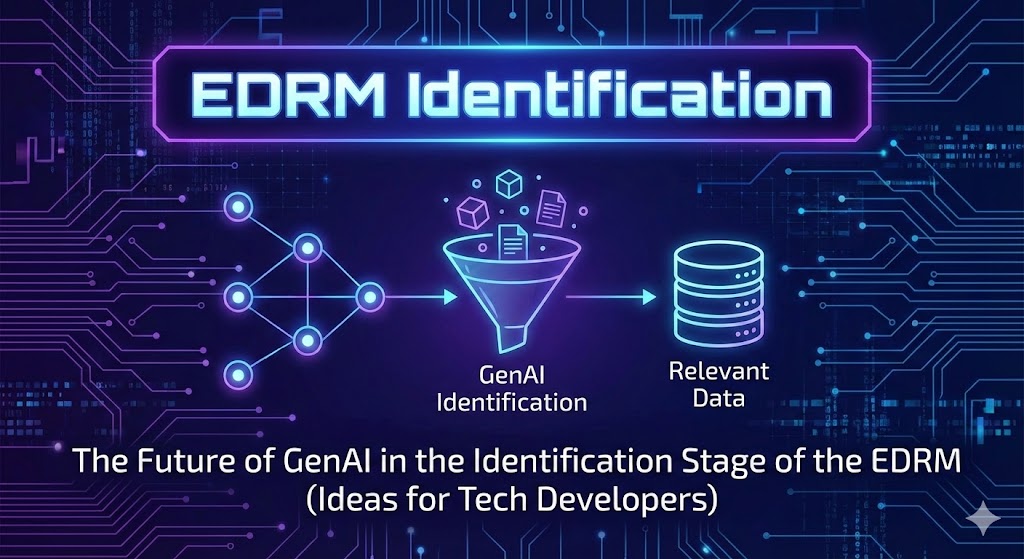
The Electronic Discovery Reference Model (EDRM) is the standard map for how organisations handle electronic evidence in disputes and investigations. The Identification stage is where teams figure out what data exists, where it lives, and which slices are likely to matter. In simple terms, it is about finding and scoping the right data at the start, before collections and review explode in cost.
Generative AI, or GenAI, is AI that can understand and create language and other content, not just match keywords. It can read an email thread, summarise a Slack channel, or answer a natural language question about call transcripts. This article speaks to developers and product builders who want concrete ideas for GenAI features in Identification.
The focus is on the near future: faster, smarter, and safer ways to spot relevant data across email, chat, audio, video, and cloud systems. The aim is to give practical ideas for features, workflows, and guardrails that you can start designing now, not science fiction.
What the Identification stage of the EDRM really needs from GenAI
Before picking models or stacks, it helps to be clear on what hurts today. Identification is full of pressure: time, cost, and risk. The pain sits in three themes developers can attack.
From keyword lists to context and intent
Most Identification work still starts with a spreadsheet of keywords and some date filters. People try a few runs, tune the list by hand, and hope they have not missed the point. This is fragile, because real conversations use slang, project code names, and polite language that hides intent.
GenAI lets users ask questions in plain English, such as “show chats where people discuss hiding costs from customers”. Large language models can map this to patterns like “burying fees”, “moving costs off invoice”, or “keep this off email”. That opens the door to generative search and LLM powered retrieval instead of guessing keyword lists.
Handling messy, multi-format data at massive scale
Identification now covers much more than email and office files. Legal teams have Slack and Teams, Confluence pages, cloud drives, ticketing tools, logs, plus audio and video from Zoom or Teams meetings. Data is messy, duplicated, threaded, and spread across systems.
Scale in 2025 often means millions of items and many terabytes. Basic indexing is not enough. GenAI can sit on top of search indexes, create shared embeddings across formats, cluster similar content, and give quick summaries. That lets teams triage what matters early, without having to read everything.
Risk, privilege, and privacy pressures
For legal and compliance teams, three fears dominate Identification: missing smoking-gun evidence, exposing privileged communications, and mishandling personal data under rules such as GDPR or CCPA. The clock is tight, so they need fast signal on where risk sits.
GenAI can help spot pockets of high-risk material early, such as dense legal advice, sensitive HR stories, or employee health issues. That sets up later features like privilege detection, PII spotting, and explainable decisions that legal teams can defend if challenged.
Core GenAI building blocks for smarter Identification
With those needs in mind, you can think in terms of core capabilities to bake into your platform. These are technical tools, but each one should map to real Identification work.
Generative search and LLM powered querying
Generative search blends vector search with large language models so users can type everyday queries and still hit the right content. The system can detect intent, rewrite vague questions, suggest extra filters, and generate follow-up questions such as “do you mean customer rebates or list prices”.
Retrieval augmented generation (RAG) is key. The model should answer only from case data, not from web training data or general knowledge, something groups like EDRM’s Generative AI project have stressed. For trust, you need ranking scores, hit snippets, and repeatable queries that lawyers can rerun and compare.
Auto classification, clustering, and topic discovery
GenAI models can classify items by issue, project, product line, or sentiment without hard-coded rules. Unsupervised clustering on embeddings can link long email chains, recurring Slack jokes, or side-channel chats about a single deal into early “case maps”.
This is powerful at Identification. Before full review, the system can surface hidden themes, show where tone in chat suddenly shifts, or highlight a small but intense cluster of messages about “off-book accounts”. Work from groups like EDRM and JD Supra on smart discovery already points in this direction.
Summarisation for rapid triage and scoping
Long documents, endless reply-all chains, and years of channel history kill time. Summarisation lets you compress these into short, plain-language overviews. You can offer thread-level summaries, channel-level summaries, custodian summaries, and “top 10 issues discussed” views for each source.
At Identification, this gives lawyers a map instead of a swamp. They can see, for example, that one engineer’s mailbox is full of vendor disputes, while another is mostly social chatter. You should support adjustable summary length and tone so outputs can match legal expectations for formality and accuracy.
Sensitive data, PII, and privilege detection
Regexes help find card numbers, emails, and phone patterns, but they miss context such as “I have been diagnosed with depression” or “please run this by outside counsel”. GenAI classifiers can spot these patterns even when the exact words vary.
A strong design blends rule-based detectors with LLM outputs. Rules catch hard facts, LLMs judge context and intent. Add PII and privilege risk scores, highlight snippets that drove the call, and log confidence levels. The Sedona Conference primer on Generative AI in discovery gives useful background on how courts are likely to question these decisions.
Future-facing GenAI ideas for Identification that tech developers can build now
With the building blocks in place, you can mix them into features that feel new but are realistic over the next few years.
Multimodal Identification across text, audio, video, and images
Imagine one GenAI layer that treats email, chat, PDFs, images, voice calls, and video meetings as a single searchable fabric. Start with speech-to-text for calls and OCR for images, then build shared embeddings that include words, visuals, and acoustic cues.
Features could include cross-channel search (“find every mention of this risk across Slack and Zoom”), auto-linking of meeting recordings to related email threads, and topic heatmaps that show when an issue bursts into life. You will need streaming-friendly pipelines so large media files can be analysed in chunks without blocking everything else.
GenAI powered “Identification copilot” for legal teams
An Identification copilot is an interactive helper inside your eDiscovery platform. It can ask clarifying questions about case issues, suggest likely data sources, propose search patterns, and explain why certain custodians or date ranges are worth including.
You can combine conversational UI, step-by-step wizards, and reusable playbooks from past matters. The guardrail is clear: this copilot should support data discovery, not give legal advice. That means careful prompt design, strong disclaimers, and controls that let admins switch features on only in suitable contexts.
Explainable AI scoring and visual risk maps
Picture every document, thread, or data source tagged with scores for relevance, privilege risk, and PII risk. The key is not just the number, but the reason. The system might show “high relevance because it mentions Project Falcon and discount approval” and highlight the matching sentences.
You can present this in dashboards with filters by custodian, time, or system, plus timeline views that show when risk spikes. Techniques such as attention highlights, short rationales, and example-based explanations help legal teams explain their process to courts and regulators.
Synthetic test data and AI sandboxes for safer development
Real case data is too sensitive for broad testing. GenAI can generate realistic but fake datasets that mimic email threads, Slack channels, policy documents, and even rare edge cases such as whistle-blower reports or subtle harassment.
You can ship scenario libraries, such as “internal fraud investigation” or “cartel chat”, and a replay tool that lets teams benchmark new models or settings without touching client data. That supports red-teaming and continuous improvement, while improving privacy and security posture.
Early authenticity checks and deepfake detection at Identification
Manipulated evidence is no longer rare. Audio, video, and images can be edited or generated in ways that are hard to spot with the naked eye. Identification is the first chance to triage this risk.
GenAI tools can run authenticity checks on ingestion, scanning for deepfake patterns, cloning artefacts, or mismatches between media and metadata. You can add authenticity scores, integrity alerts, and a workflow queue for expert review of flagged items. This is a strong area for specialised models and partnerships with vendors focused on media forensics.
Adaptive, case-specific models that learn during a matter
Generic models are a blunt tool. The language, names, and slang of a case are highly local. Adaptive, case-specific models or small adapters can refine behaviour as the team labels examples.
You can support incremental tuning, active learning loops where reviewers confirm or reject relevance calls, and rolling updates to embeddings as new data lands. This demands tight control of versioning and clear records of which model version made which decision, but pays off in higher quality over the life of a matter.
Technical and ethical guardrails for GenAI in eDiscovery Identification
Smart features are not enough. For eDiscovery clients, trust and defensibility are as important as speed. That starts with how you design guardrails.
Designing for legal defensibility and audit trails
Courts and regulators will ask how AI tools were used during Identification. Your system should be able to answer that question with evidence, not guesses. Every AI-assisted action should be logged, including prompts, model versions, inputs, outputs, user overrides, and timestamps.
Support reproducible search runs and exportable reports that describe how GenAI was used in plain language. Litigation teams can then include these in protocol documents or share them with opposing counsel. Work like the ACEDS discussion of GenAI’s contribution to e-discovery shows how important this transparency has become.
Privacy, data residency, and model deployment choices
Clients care where their data sits and who can see it. GenAI features must respect data residency, sector rules, and contractual promises. You will often need options for on-premise models, private cloud, or VPC-hosted services that do not train on client data.
A simple way to think about deployment is to offer patterns such as:
| Pattern | Typical use case |
|---|---|
| On-premise models | Highly regulated or government clients |
| Private cloud, single tenant | Large enterprises with strict security needs |
| Managed SaaS with strong DPA | Mid-market firms and corporates |
Add data minimisation at ingestion, strict access controls, and early redaction for sensitive fields so they never hit the model.
Bias, error handling, and human-in-the-loop workflows
GenAI will make mistakes, and it will reflect bias in training data if left unchecked. You should design for this instead of pretending it will not happen. Provide confidence scores, clear “not sure” states, and guardrails that prevent full automation of sensitive calls such as privilege.
UX matters here. Make it easy for reviewers to challenge and correct AI suggestions, and feed that feedback into model tuning. Treat AI as a partner that proposes, while humans dispose, especially on high-risk steps.
Practical steps for tech developers starting with GenAI in Identification
With so many options, it helps to have a simple starting path. Think of it as three loops: understand work, pick a stack, then ship small and learn.
Work with legal teams to map real Identification workflows
Sit with litigation support, eDiscovery managers, and lawyers as they run early case assessments. Watch how they write search terms, how they choose custodians, and where they get stuck. Capture typical queries, data sources, deadlines, and “oh no” moments.
Turn these into journey maps that show where GenAI could remove steps or add insight. Let those maps, not only technical excitement, drive your feature backlog. Articles like Jatheon’s look at AI reshaping the eDiscovery lifecycle can help you benchmark what users already expect.
Choose the right GenAI stack and evaluation metrics
You will need to pick LLMs (hosted or open source), a vector database, orchestration tools, and observability for prompts and outputs. The stack matters, but your evaluation setup matters more.
For Identification, track precision and recall for early searches, accuracy of PII and privilege flags, time saved for users, and simple trust scores (“how much do you trust this suggestion?”). Build test sets from closed matters so you know the ground truth and can compare models without guesswork. The EDRM and JD Supra introductions to GenAI for discovery offer good context here.
Ship small, high-impact features and iterate safely
Rather than trying to automate all of Identification in one go, start with narrow features that solve clear pains. Examples include natural language query suggestions, summarisation of hit sets, or risk scoring for small pilot custodians.
Wrap these in feature flags, A/B tests, and opt-in beta groups with trusted clients. Label AI-generated outputs clearly, keep a manual fallback, and be ready to roll back if needed. Small, well-adopted wins build confidence and lay the foundations for a fuller GenAI Identification layer over time.
Conclusion
GenAI will change the Identification stage of the EDRM from manual keyword hunting into a guided, intelligent discovery process. For developers, the opportunity sits in generative search, multimodal processing, risk-aware scoring, authenticity checks, and adaptive models that learn from each matter, all wrapped in strong legal and ethical guardrails.
The next few years will reward teams that partner closely with legal users, start with targeted high-value features, and design with transparency from day one. If you build tools that are both smart and explainable, you will help legal teams handle the flood of data with far more confidence.
Now is a good moment to pick one Identification pain point, talk to your users, and sketch the first GenAI-powered feature that could relieve it.